Introduction
You’ve completed your medical coding course — now comes the big question:
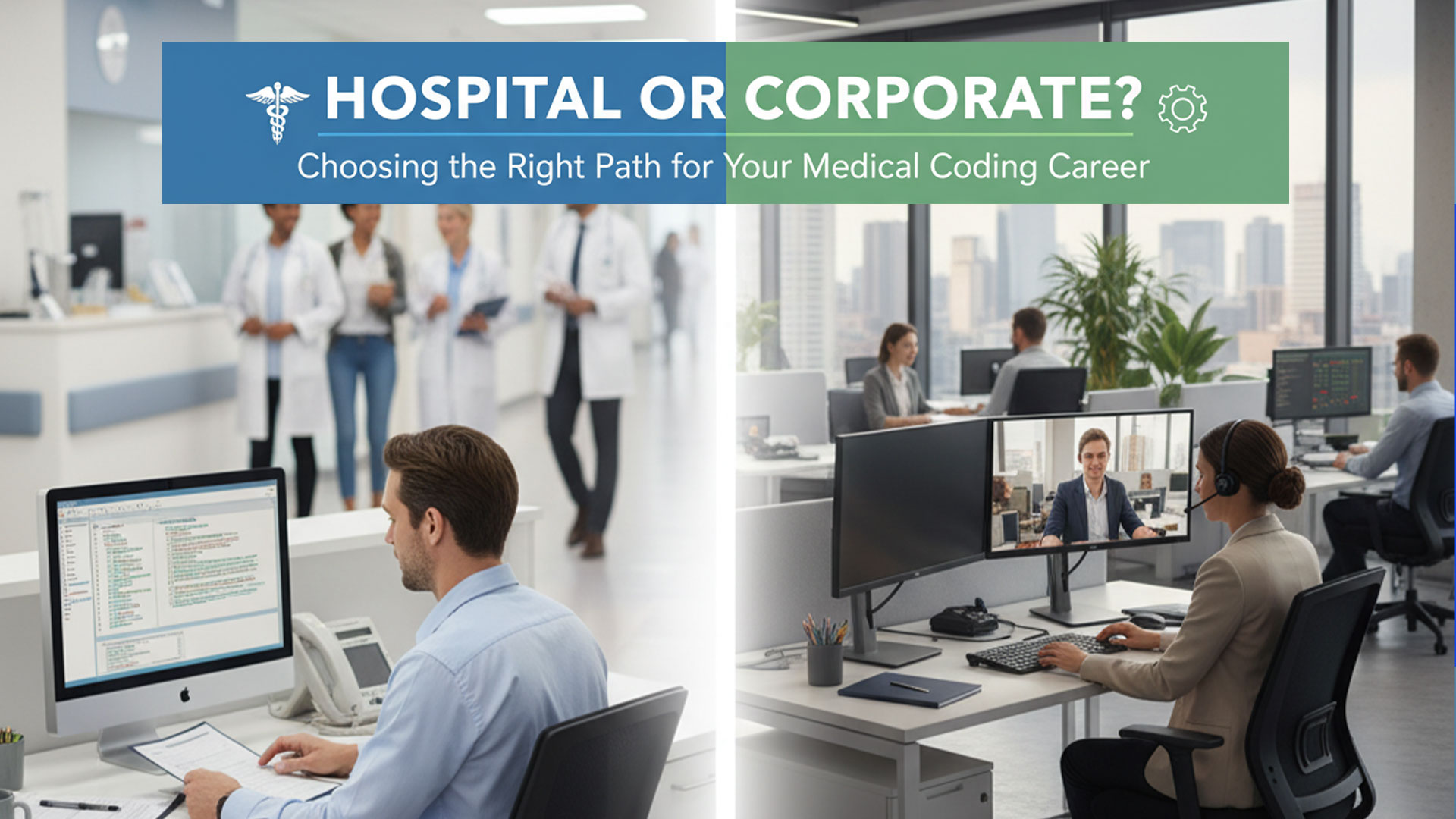
Should you work in a hospital or a corporate company?
Both offer great opportunities, but your career path depends on your skills, interests, and long-term goals.
1.Hospital-Based Coding
In hospitals, coders work closely with doctors and patient charts.
You’ll gain a strong understanding of clinical documents and real-time patient cases.
Advantages:
- Exposure to live medical records
- Deep understanding of diseases and procedures
- Ideal for those who love clinical accuracy
Challenges:
- Moderate salary for beginners
- Fast-paced environment
2.Corporate (BPO/KPO) Medical Coding
Corporate medical coding companies handle outsourced work from hospitals abroad.
Here, the focus is on productivity, audits, and client quality.
Advantages:
- Higher starting salary
- Structured training and growth
- Opportunity to work for US healthcare clients
Challenges:
- Repetitive work
- Limited clinical interaction
3.Which Is Better for You?
If you love clinical detailing, shift to hospital-based coding after gaining experience.
If you’re a fresher, start with a corporate setup — you’ll learn coding standards, audits, and QA processes.
The smartest coders often explore both sides for a well-rounded career.
4.Career Growth Opportunities
Both paths lead to advanced roles such as:
- Senior Coder / Quality Analyst
- Medical Coding Auditor
- Team Lead / Trainer
And with certifications like CPC or CCS, you can easily move to US-based remote coding jobs.
People Also Ask
Q: Which is better — hospital or corporate medical coding?
A: Both have benefits. Corporate coding offers higher starting pay, while hospital coding gives deeper clinical exposure.
Q: Can I switch from hospital to corporate coding later?
A: Yes, many coders start in one environment and move to the other for better exposure and growth.
Q: What skills are required for hospital-based coding?
A: Strong knowledge of ICD-10 codes, anatomy, and medical terminology is essential.
Q: Do corporate medical coders work night shifts?
A: Sometimes, yes — since many projects are from US clients, shifts may align with international time zones.
Q: Which type of coding offers better growth?
A: Corporate setups often have structured promotions and international opportunities, but hospitals offer long-term job security and stability.
Conclusion
There’s no wrong choice — both hospital and corporate medical coding careers offer excellent stability and growth.
Start where you can learn the most, and your skills will take you anywhere in the global healthcare world.